

Infrared Thermometers price list
Last updated Saturday, Oct 17, 2026




View 7 Offers
Loading...
Last updated Saturday, Oct 17, 2026
Infrared thermometers make temperature checks quick, clean, and contact-free. Instead of touching a surface with a probe, you point the device, press the trigger, and read the result. It is a little like using a camera that sees heat rather than color. That convenience can be useful for HVAC work, equipment checks, cooking, maintenance, and many other tasks.
ZoneOffer is a comparison site that helps you review available products and prices from listed sellers. The infrared thermometers in this guide include compact handheld models, industrial tools with broad measuring ranges, adjustable emissivity, laser targeting, color displays, and additional functions. Which one is right for you? The answer depends on the temperatures you need to measure, the surfaces involved, and how much control you want over targeting and settings.
An infrared thermometer measures the thermal energy released by an object and converts that reading into a temperature displayed on the screen. Because the device does not need to touch the target, you can check hot, cold, moving, distant, or difficult-to-reach surfaces from a safer position.
Most of the models in the reference data include a laser pointer or laser targeting system. The laser does not measure the temperature by itself. Instead, it helps you aim at the area being measured. This distinction matters because the measured area becomes larger as you move farther away from the target.
Non-contact measurement can save time and reduce the need to interrupt equipment or handle hot objects. A handheld infrared thermometer may help you inspect machinery, check air-conditioning components, examine cooking surfaces, or compare temperature changes across an object.
However, these tools measure surface temperature rather than the internal temperature of an object. The BSIDE product listing specifically notes that it is not suitable for measuring human or animal body temperature. Treat an infrared thermometer as a surface-checking instrument, not a universal medical thermometer.
Two infrared thermometers can look similar while serving very different purposes. Before choosing, focus on measuring range, accuracy information, distance-to-spot ratio, emissivity adjustment, display type, response time, and extra modes.
The temperature range tells you the coldest and hottest surfaces the product is designed to measure. For general household and maintenance tasks, a mid-range model may be sufficient. For industrial inspections, a wider range gives you more flexibility.
The ANENG TH104 covers approximately -58°F to 1,022°F. The UNI-T UT306S and UT306C models cover approximately -58°F to 932°F. The ANENG TH202 and TH203 reach about 1,112°F, while the MESTEK IRO2C measures from approximately -58°F to 1,472°F.
For especially high-temperature applications, the MESTEK IR05 family offers different versions. The IR05 reaches approximately -40°F to 2,192°F, the IR05A reaches approximately -40°F to 2,912°F, and the IR05B reaches approximately -40°F to 3,632°F. The BSIDE model covers approximately -58°F to 2,552°F.
Accuracy describes how close the displayed reading may be to the actual surface temperature, while resolution describes how finely the result is displayed. The UNI-T listing states an accuracy of either 2% or 2°C, with a resolution of 0.1°C. Converted for readers using imperial measurements, the resolution is approximately 0.18°F, while the stated temperature tolerance should be reviewed carefully alongside the selected unit setting.
The MESTEK IRO2C listing provides different accuracy specifications across its range. It states 3°C accuracy between -50°C and 0°C, and 1.5% of the reading plus 2°C between 0°C and 800°C. In Fahrenheit terms, those ranges are approximately -58°F to 32°F and 32°F to 1,472°F.
Accuracy can also be affected by the target surface, distance, angle, and emissivity setting. A precise number on the screen is not automatically a perfect measurement. Good technique is just as important as the device specification.
The distance-to-spot ratio explains how large the measured area becomes as you move away. A 12:1 ratio means that the measurement area is roughly one-twelfth of the distance from the target, under the product’s stated design. If you stand farther back, the thermometer may include surrounding surfaces in its reading.
Several listed products, including the UNI-T UT306S and UT306C, the MESTEK IRO2C, the MESTEK 800-series model, and the ANENG TH202 and TH203, feature a 12:1 distance-to-spot ratio. The BSIDE model lists a 50:1 ratio, which is designed for measuring from farther away with a narrower target area.
Here is a simple way to picture it: the measurement spot behaves like an invisible cone. The farther the cone travels, the wider it becomes. For small components, aim carefully and move closer when appropriate.
The ANENG TH104 is listed at $24.99 from Banggood.com. It offers a measuring range of approximately -58°F to 1,022°F, making it a flexible option for general temperature checks and many maintenance tasks.
This model combines an infrared laser sensor with a thermal imaging feature intended to help visualize heat distribution. Its VA screen is designed for clear viewing, while the handheld format supports portable, one-handed use. The listing positions it for applications including HVAC work, cooking, and general temperature checks.
If you want a broad-range tool without moving into the highest-temperature category, the TH104 may be worth comparing. Its thermal imaging feature could also appeal to users who want more than a single point-style reading.
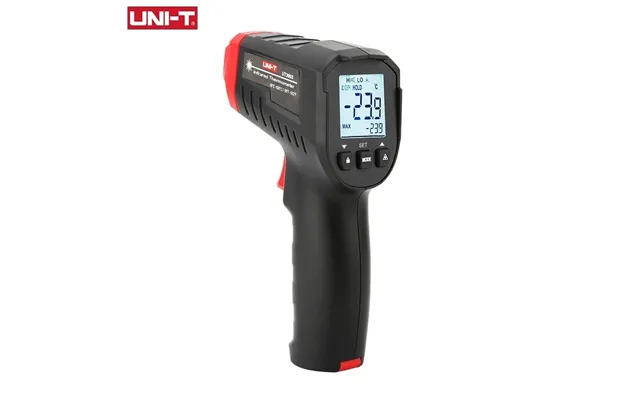
The UNI-T UT306S and UT306C are listed at $19.99 from Banggood.com. Both versions offer a range of approximately -58°F to 932°F, a 12:1 distance-to-spot ratio, adjustable emissivity from 0.1 to 1.0, and a response time of 250 milliseconds.
The product listing includes single-circle laser targeting, a TN LCD display, selectable temperature units, data hold, automatic power-off, low-battery indication, and high- and low-temperature alarms. Maximum, minimum, average, and difference modes are also listed.
The thermometer is described for uses such as food work, machine maintenance, metalworking, cold storage, and other industrial applications. Batteries are not included according to the listing, so remember to account for two AAA batteries when preparing to use it.
The MESTEK IR05 series is designed around very broad temperature coverage. The listed price is $99.00 from Banggood.com. The available versions cover approximately -40°F to 2,192°F, -40°F to 2,912°F, or -40°F to 3,632°F, depending on whether you select the IR05, IR05A, or IR05B.
The listing describes a response time of less than 0.5 seconds and highlights multipurpose use for checking heat levels associated with humidity, water, oil, and air-conditioning temperatures. A VA reverse display color screen is included among the described features.
This family is most relevant when a standard household temperature range is not enough. Think of it as choosing a longer measuring tape: you may not need the extra reach every day, but it can become essential for specialized work.
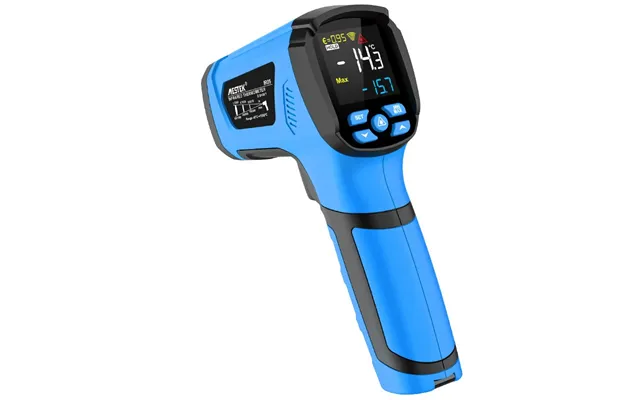
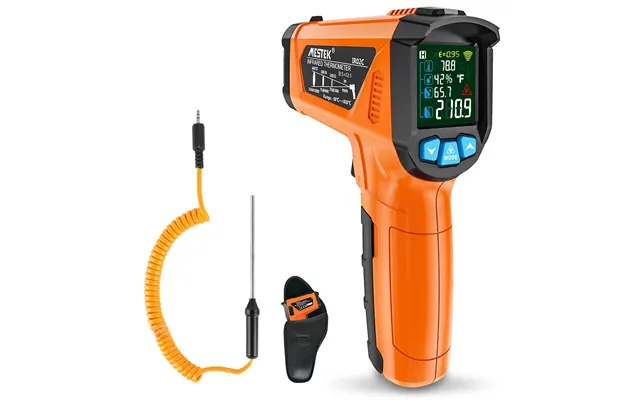
The MESTEK IRO2C is listed at $39.99 from Banggood.com. It covers approximately -58°F to 1,472°F and includes adjustable emissivity from 0.1 to 1.0. That adjustment can help you adapt readings for different surface materials and finishes.
The listing also describes 12-point laser targeting with a V-shaped laser spot. Multiple points can make the target area easier to understand than a single pointer, particularly when you are trying to center the measurement on a surface.
With its broad range and adjustable settings, the IRO2C is a practical middle ground between basic handheld thermometers and specialized high-temperature instruments. It may suit users who want more control without selecting the highest-range model in the comparison.
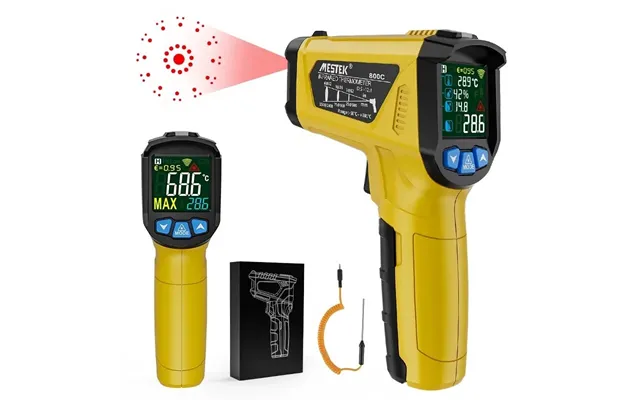
This MESTEK model is listed at $47.00 from Banggood.com. It measures approximately -58°F to 1,472°F and features a 12-point laser system, an inverted color screen, adjustable emissivity from 0.1 to 1.0, and a 12:1 distance-to-spot ratio.
The listing identifies several measurement functions, including temperature difference, maximum and minimum values, ambient temperature, humidity, mildew temperature, and dew point measurement. The 800C version also includes a contact probe for liquid temperature measurement, while the listing identifies the probe for the 800B and 800C versions.
Because the versions differ, check the selected model carefully. Not every function or accessory applies to every version. Batteries are not included, and the specified battery type is two AAA batteries.
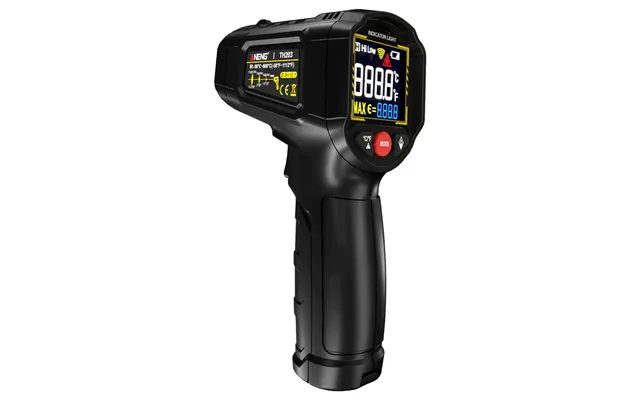
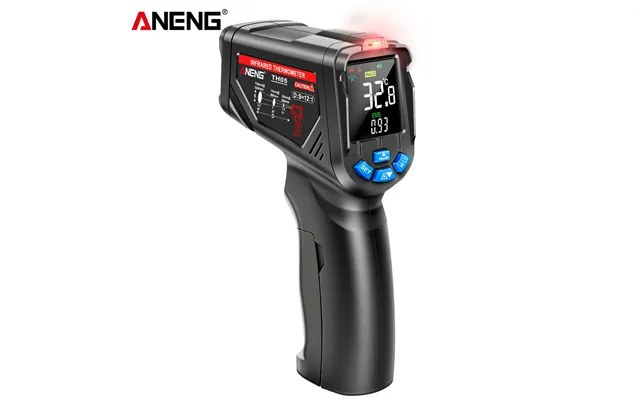
The ANENG TH202 and TH203 are listed at $35.00 from Banggood.com. Both cover approximately -58°F to 1,112°F, use a 12:1 distance-to-spot ratio, and provide adjustable emissivity with a default setting of 0.95.
The TH202 uses a single laser and a backlit LCD screen. The TH203 adds multi-point laser positioning and a VA reverse color screen. Both versions include automatic shutdown, a low-power prompt, and data retention, according to the listing.
These models are useful to compare if you want a compact instrument with a higher range than an entry-level thermometer. The choice between them mainly centers on display style and single-point versus multi-point targeting.
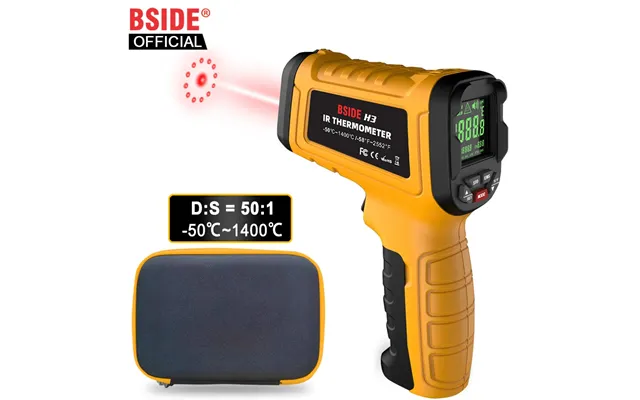
The BSIDE infrared thermometer is listed at $49.99 from Banggood.com. It covers approximately -58°F to 2,552°F and provides a 50:1 distance-to-spot ratio. That ratio is the standout feature because it is intended to support measurements from a greater distance while maintaining a narrower target area.
The listing includes a color-backlit LCD, laser targeting, one-handed operation, a low-battery indicator, automatic power-off after 30 seconds without operation, display hold, and selectable temperature units. It uses two AAA batteries, which are not included.
The product description also includes a caution about boiling liquids: steam or water vapor should not contact the sensing area, and the measurement angle should be kept between 45 and 60 degrees. These details show why technique matters even when the thermometer has a wide range.
Start by reading the target area and choosing a surface that represents what you actually want to know. Pointing at a shiny edge, a nearby reflection, or a mixture of hot and cool areas can produce a misleading result.
Keep the thermometer aimed steadily and use the laser as a guide rather than assuming it marks the entire measurement area. If the target is small, move closer or choose a product with a higher distance-to-spot ratio, such as the BSIDE model listed with a 50:1 ratio.
For materials with different surface finishes, use adjustable emissivity when available. The UNI-T UT306S and UT306C, MESTEK IRO2C, MESTEK 800-series model, and ANENG TH202 and TH203 all list emissivity adjustment. This feature is especially relevant when you compare readings across painted, dull, metallic, or reflective surfaces.
Take extra care around steam, splashing, and reflective liquid surfaces. The BSIDE listing specifically warns against allowing vapor to contact the temperature-sensing area when measuring boiling liquids. The MESTEK 800-series listing identifies a contact probe for certain versions, which may be more appropriate for liquid measurements when that accessory is included with the selected model.
Never assume that a laser thermometer measures the temperature inside a container. It reads the surface it sees. If you need an internal reading, select a product and method designed for that purpose.
The ANENG TH104, UNI-T UT306S or UT306C, and ANENG TH202 or TH203 offer broad ranges for many everyday inspection tasks. Compare their displays, targeting systems, listed modes, and prices rather than focusing only on the maximum temperature.
The ANENG TH104 listing mentions HVAC applications, while the UNI-T range includes machine maintenance and industrial uses. The MESTEK IRO2C and 800-series models add broad ranges and adjustable emissivity, which may be useful when surface types vary.
The MESTEK IR05 family and BSIDE model stand out for higher listed temperature limits. The right choice depends on how hot the targets are, how far away you need to stand, and whether you need a very broad range or a high distance-to-spot ratio.
The listed prices range from $19.99 to $99.00. The UNI-T UT306S and UT306C are listed at $19.99, followed by the ANENG TH104 at $24.99, the ANENG TH202 and TH203 at $35.00, the MESTEK IRO2C at $39.99, the MESTEK 800-series model at $47.00, and the BSIDE model at $49.99. The MESTEK IR05 family is listed at $99.00.
These are comparison details from the supplied listings, not a guarantee that every option will suit every task. A lower price can be attractive, but a wider range, adjustable emissivity, multi-point targeting, or a specialized display may offer better value for your particular work.
Infrared thermometers turn surface temperature checks into a fast point-and-read process. For compact general use, compare the ANENG and UNI-T options. For adjustable settings and broad coverage, consider the MESTEK IRO2C or 800-series model. For very high temperatures, review the MESTEK IR05 range or BSIDE thermometer. ZoneOffer lets you compare these listed products and prices in one place, helping you choose the tool that matches your temperature range, targeting needs, and working style.