
Video Transmitters price list
Last updated Tuesday, Sep 29, 2026




View 14 Offers
Loading...
Last updated Tuesday, Sep 29, 2026
Choosing the right video transmitter can feel like picking a road through a maze. Some models are built for wireless presentations, others extend HDMI signals across a room, while compact FPV transmitters send live video from drones and aircraft. The best option depends on your distance, resolution, connection type, control features, and installation environment.
ZoneOffer is a comparison site that helps you review available products and prices in one place. The reference data includes video transmitters and extender systems from AV Access, EDUP, and GEPRC, with listed prices ranging from $29.99 to $1,099.00. In this guide, you’ll see what each product category does, which features matter, and how the listed models compare.
A video transmitter sends visual and sometimes audio information from a source to a display or receiver. The source could be a laptop, camera, media player, drone, or other video device. Depending on the product, the signal may travel through a cable, a wireless connection, or a dedicated transmitter-and-receiver pair.
Think of a transmitter as a messenger. It takes the picture from one device and carries it to another screen. The quality of that message depends on factors such as resolution, range, latency, signal stability, ports, and compatibility.
The products in this comparison cover several use cases. AV Access offers wireless presentation systems, USB-C casting dongles, and HDMI extenders. EDUP provides a wireless HDMI-compatible transmitter and receiver kit for screen projection. GEPRC focuses on FPV radio video transmission for RC drones and airplanes.
Wireless presentation systems are designed to make screen sharing easier in meeting rooms, classrooms, and collaborative spaces. Instead of relying on a long cable running across a table, a presenter can use a compatible transmitter or casting dongle to send content to a central system.
The AV Access eShare W80 is a 4K wireless conferencing system for video presentations and collaboration. It includes dual HDMI outputs and a multiview feature, making it a strong match for environments where several visual sources or displays need to be managed. Its listed price is $1,099.00.
Because the eShare W80 is described as a complete conferencing system, it may be more suitable for a dedicated meeting-room setup than for occasional home use. It is also compatible with the eShare D20 USB-C casting dongle, which is designed for one-click wireless conferencing.
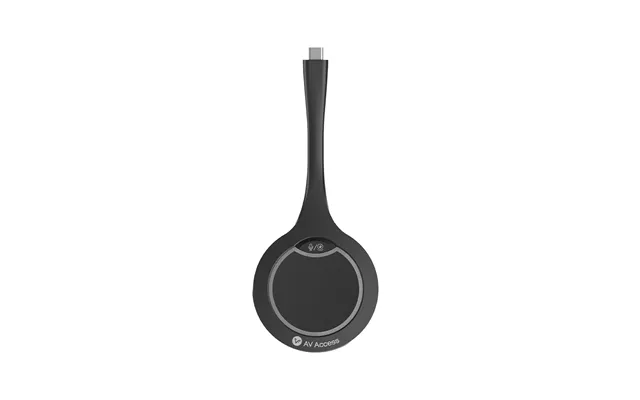
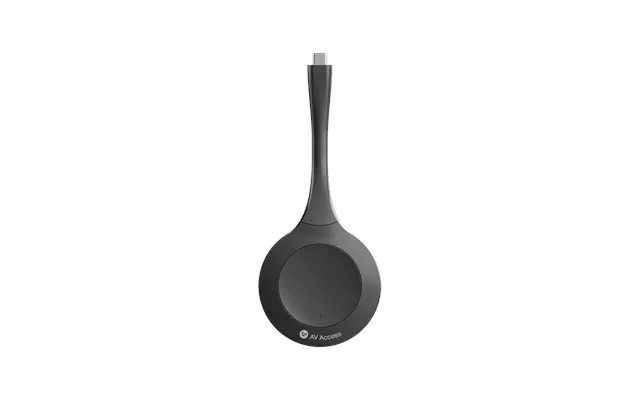
The AV Access eShare D20 is a USB-C casting dongle that works with the eShare W80. The listing highlights 4K UHD support and operation without software. That plug-and-play approach can make it easier for guests or employees to connect without installing an application first.
Its listed price is $259.00. If your priority is simple wireless conferencing with an eShare W80 system, the D20 is the dedicated accessory in this selection. It is not presented as a standalone conferencing system, so compatibility with the W80 is an important part of its role.
The AV Access eShare D10 is a USB-C dongle for wireless casting and includes button control. It works with the eShare W50 wireless presentation system. The product is listed at $199.00.
The D10 and D20 serve similar broad purposes, but they are designed for different eShare systems. The D10 is associated with the W50, while the D20 works with the W80. Checking the target system before choosing a dongle is essential; the connector may look familiar, but compatibility is the real key.
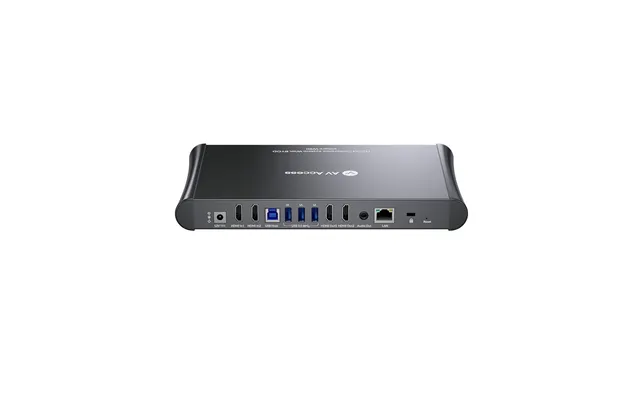
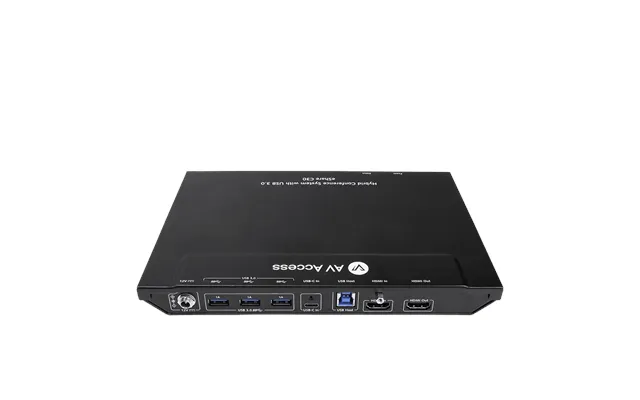
The AV Access eShare C30 is a 4K presentation system with USB-C and HDMI inputs. The listing describes it as a two-input hybrid conference system for small and medium meeting rooms. It also supports USB 3.0 peripherals, including 4K webcams and speakerphones.
With a listed price of $159.99, the C30 is one of the lower-priced AV Access options in the reference data. Its plug-and-play design does not require software or drivers, according to the listing. That can be useful when you want to connect presentation equipment quickly and avoid a complicated setup.
The C30 may appeal to teams that need more than simple screen casting. USB-C and HDMI inputs give users two common ways to connect devices, while USB 3.0 peripheral support can help bring cameras and audio equipment into a conference workflow.
HDMI extenders solve a different problem from wireless casting dongles. Rather than sending a presentation wirelessly from a laptop, an extender carries an HDMI signal over a longer distance, often using a network-style cable or a wireless link.
AV Access offers several HDBaseT HDMI extenders in the reference data. These products are aimed at installations such as home theaters, offices, churches, classrooms, and other spaces where the display cannot sit close to the source.
When comparing an extender, look beyond the word “4K.” You should also consider the supported distance, cable type, refresh rate, audio features, infrared control, power options, and control standards. A model designed for a short 4K run may not suit a longer installation, while a lower-resolution wireless extender may be ideal for a projector or secondary display.
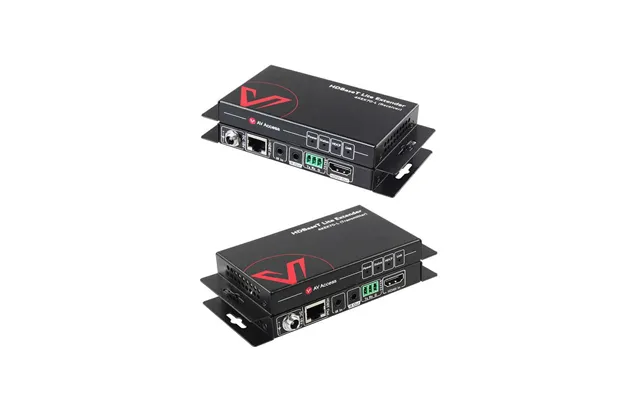
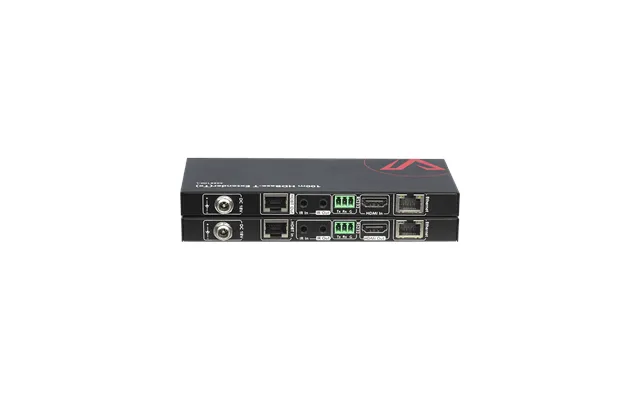
The AV Access 4KEX70-L is described as an economical 4K HDBaseT HDMI extender with two-way IR, CEC, PoE, and RS232. The listing says it transmits a 4K HDMI signal up to 40 meters, which is approximately 131 feet. Its listed price is $109.99.
This model may fit buyers who want a wired extension solution with control features without choosing one of the more expensive options in the comparison. Its combination of 4K support and installation-oriented functions makes it relevant for equipment racks, display systems, and structured AV setups.
The AV Access 4KEX100-L is a 4K HDMI extender over HDBaseT. The listing states that it can extend a 4K signal up to 70 meters, or approximately 230 feet, through a single Cat 5e or Cat 6 cable, and up to 100 meters, or approximately 328 feet, through a single Cat 6a or Cat 7 cable.
It also includes bi-directional PoE, IR, and RS232. At a listed price of $219.00, it costs more than the 4KEX70-L, but its stated transmission distances are longer. If your installation stretches across a large room, hallway, or building section, distance may matter more than saving a few dollars upfront.
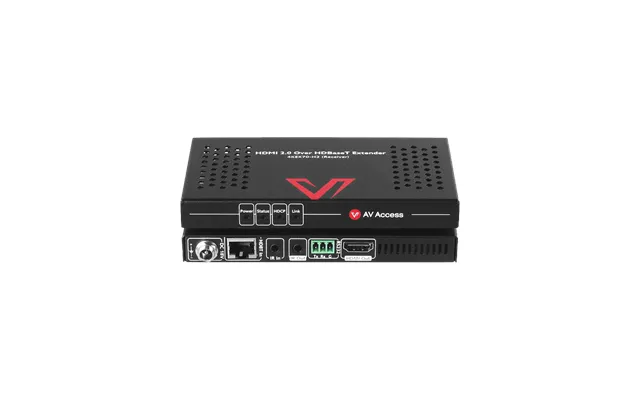
The AV Access 4KEX70-H2 supports resolutions up to 4K at 60 Hz with 4:4:4 8-bit color, along with HDCP 2.2 and HDR10. The listing states that it can transport HDMI signals up to approximately 131 feet at 4K and approximately 230 feet at 1080p through a Cat-style cable.
Two-way IR, PoE, and RS232 are also listed among its features. The price shown is $149.99. This model is worth considering when image detail, HDR support, and control capabilities are all important parts of the installation.
Home theater installations often need more than image transmission. Audio return features, infrared control, and compatibility with display-control standards can make the difference between a smooth system and a frustrating one.
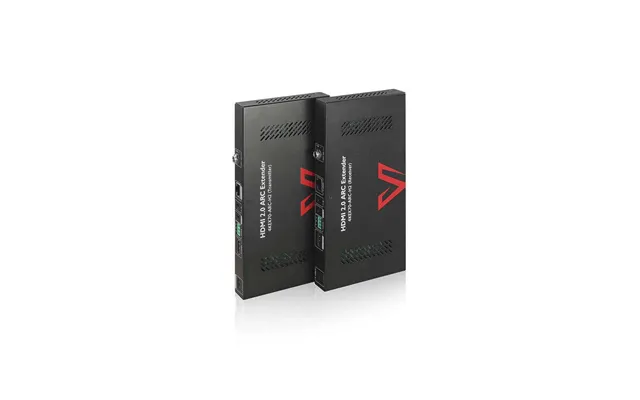
The AV Access 4KEX70-ARC-H2 is a 4K HDMI extender with ARC and SPDIF audio extension. It also lists two-way IR, CEC, PoC, and RS232, and is described as ideal for home theater use. Its listed price is $239.99.
ARC can be useful in setups where audio needs to travel back through the HDMI connection. The addition of SPDIF extension gives this model a more audio-focused feature set than a basic video extender. If your system includes a separate audio component, those details deserve close attention.
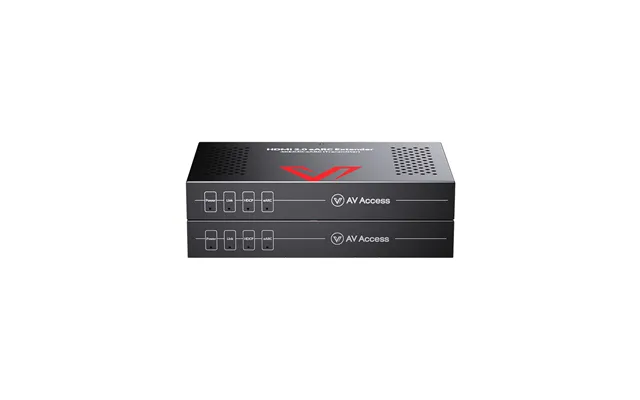
The AV Access 4KEX40-eARC is described as a new 4K HDBaseT HDMI extender with eARC and ARC. Its listing also mentions CEC and PoC, along with home theater use. The listed price is $359.99.
This is the highest-priced HDMI extender in the AV Access selection. Its appeal is centered on enhanced audio-return support rather than simply extending a picture from one room to another. For buyers planning a modern home theater, eARC and ARC may be deciding features.
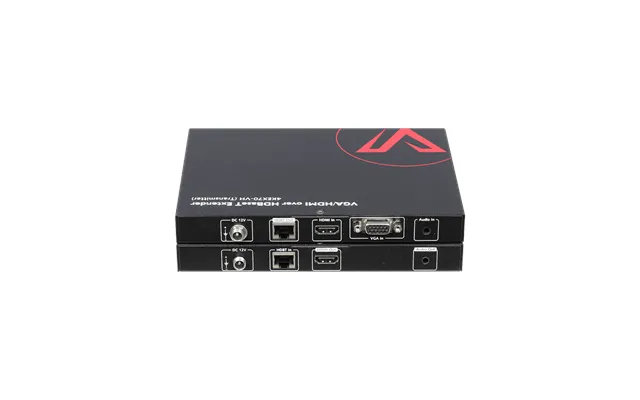
The AV Access 4KEX70-VH is a 4K HDMI and VGA HDBaseT extender with two-way IR, RS232, and VGA audio pass-through. The listing states that it can extend 1080p at 60 Hz up to approximately 230 feet and 4K at 60 Hz up to approximately 131 feet using a single Cat 6a or Cat 7 cable.
Its listed price is $245.00. The inclusion of VGA makes it different from the HDMI-only models. That can matter in older office, education, or presentation environments where legacy computers still use VGA output.
Wireless HDMI extenders can reduce the need to route long cables between a source and a display. They may be useful for projectors, televisions, home theaters, offices, and churches. However, wireless products should be chosen with their intended range, latency, and control functions in mind.
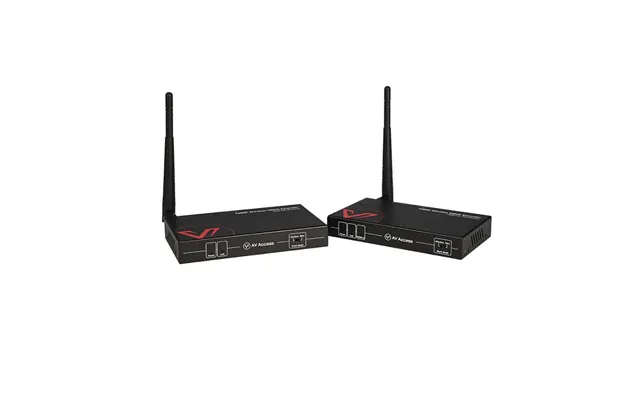
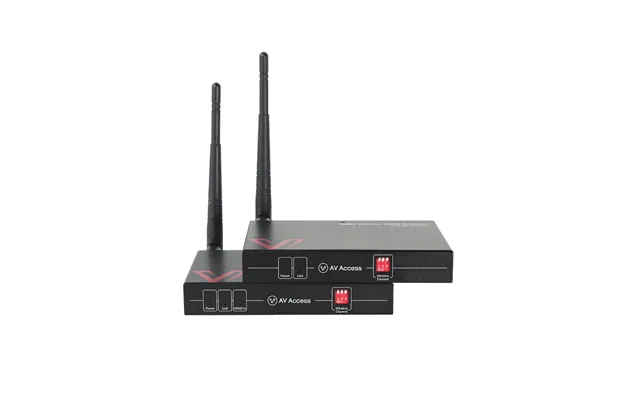
The AV Access HDW100 is a wireless 1080p HDMI extender with a listed transmission range of up to 200 meters, or approximately 656 feet. It includes IR remote control and low-latency operation, and the listing identifies it as suitable for home theater and projector use.
The listed price is $145.99. This product may be a practical match when you want wireless Full HD transmission rather than 4K. Its stated low-latency design is especially relevant when a noticeable delay would make viewing or presentations less comfortable.
The AV Access HDW200 is another wireless 1080p HDMI extender with a maximum stated range of up to approximately 656 feet. It adds a loop-out feature and supports deployment of up to five pairs, according to the listing. The product is described as suitable for home theater, office, and church use.
Its listed price is $165.99. The loop-out feature can be useful when the source needs to feed another display or local monitor as well as the remote screen. Buyers comparing the HDW100 and HDW200 should ask a simple question: do you need loop-out and multi-pair deployment, or is a straightforward wireless link enough?
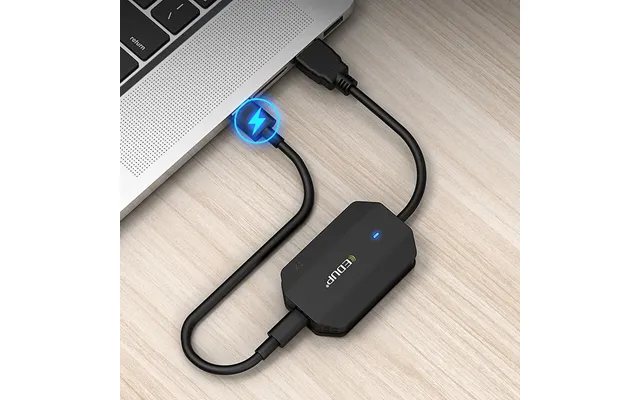
The EDUP wireless transmitter and receiver kit is listed at $59.99, making it the lowest-priced general-purpose video transmission product in the reference data. It supports 1080p output and is designed for use with a PC, TV, or projector.
The listing describes wireless same-screen projection, including mirroring and second-screen display modes. It also highlights 1080p at 60 Hz, support for multiple video and audio formats, and a 5 GHz signal intended to provide stable transmission with resistance to interference.
The package is listed as including two USB cables, an English manual, an HDMI adapter, one transmitter, and one receiver. The stated device dimensions are approximately 1.7 inches by 1.7 inches by 8.1 inches, using the supplied measurements converted to imperial units.
This kit may suit users who want a relatively simple way to project a computer screen onto a larger display. It is important to distinguish it from the AV Access HDW models: the EDUP listing emphasizes PC, TV, and projector screen extension, while the AV Access models provide more installation-specific details such as IR control, loop-out, or longer stated ranges.
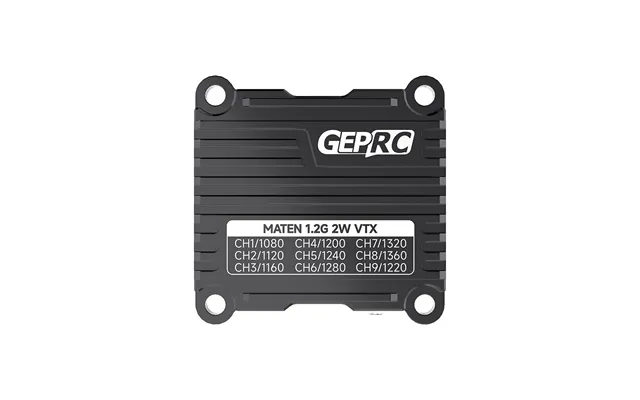
The GEPRC Maten 1.2 GHz 9-channel FPV transmitter is designed for RC drones and airplanes rather than meeting rooms or home theater systems. It offers four adjustable power levels: 25 mW, 400 mW, 800 mW, and 2,000 mW, with pit mode also listed.
The product supports nine channels and the IRC Tramp control protocol. The listing also describes a high-strength aluminum alloy CNC shell, temperature-control protection, and a wide input range from 7 to 36 volts. Its installation pattern is listed as approximately 1.2 inches by 1.2 inches with M3 mounting holes.
The frequency range is listed from 1,080 MHz to 1,360 MHz. The product includes one function button and two indicator lights, according to the listing. Its listed price is $29.99, making it the least expensive product in the comparison, but it serves a specialized FPV purpose.
Do not compare this model directly with an HDMI extender as if they were interchangeable. The GEPRC transmitter is built for onboard video transmission in RC applications. Its adjustable output power, channel selection, thermal protection, and flight-oriented control features are the important points to examine.
Start with the source and destination. Are you sending a laptop presentation to a conference display, extending a home theater signal, connecting a computer to a projector, or transmitting an FPV camera feed from an aircraft? Once you answer that question, many unsuitable products disappear immediately.
Next, decide whether you need wired or wireless transmission. Wired HDBaseT models can be attractive for structured installations, while wireless extenders can simplify setups where running cable is difficult. Wireless presentation dongles are more focused on convenience and collaboration than on permanent infrastructure.
Resolution is another major checkpoint. The reference data includes 4K products and 1080p products. If your source and display both support 4K, a 4K extender or presentation system may help you preserve that detail. If your display is Full HD, a 1080p solution may be sufficient.
Distance matters just as much. The listed AV Access wired models range from approximately 131 feet to approximately 328 feet depending on the product and cable type. The HDW100 and HDW200 list wireless ranges up to approximately 656 feet. Treat these figures as product specifications, not a guarantee that every room or building will produce identical results.
Finally, consider control and audio. IR, RS232, CEC, ARC, eARC, SPDIF, PoE, and loop-out each serve different needs. You may not need every feature, but the right one can make your system much easier to operate.
The listed prices span a wide range. The GEPRC Maten is shown at $29.99, while the EDUP kit is listed at $59.99. AV Access options include the 4KEX70-L at $109.99, HDW100 at $145.99, 4KEX70-H2 at $149.99, HDW200 at $165.99, and eShare C30 at $159.99.
Higher-priced models include the 4KEX100-L at $219.00, 4KEX70-ARC-H2 at $239.99, 4KEX70-VH at $245.00, eShare D20 at $259.00, and 4KEX40-eARC at $359.99. The eShare W80 is listed at $1,099.00.
Price alone does not determine value. A $29.99 FPV transmitter and a $1,099.00 conferencing system are designed for completely different jobs. The smartest comparison matches the product’s features to your actual setup instead of treating the lowest price as the automatic winner.
The best video transmitter is the one that fits your signal, distance, display, and environment. Choose an eShare system or dongle for wireless conferencing, an HDBaseT extender for structured HDMI installations, a wireless HDMI model for cable-free Full HD connections, an EDUP kit for basic screen projection, or the GEPRC Maten for FPV applications.
Before making a decision, compare resolution, range, connection standards, audio support, control features, and the listed price. ZoneOffer provides a convenient way to compare these products, but it is a comparison site rather than a store. Use the product details as your starting map, then confirm that the model matches your equipment and intended use.