

Hospital Gowns price list
Last updated Wednesday, Oct 21, 2026
| Hospital Gowns | Price |
|---|---|
| Lightweight Isolation Gown - Yellow | $10.93 |
| Lightweight Isolation Gown - Yellow | $10.93 |

Loading...
Last updated Wednesday, Oct 21, 2026
| Hospital Gowns | Price |
|---|---|
| Lightweight Isolation Gown - Yellow | $10.93 |
| Lightweight Isolation Gown - Yellow | $10.93 |
Choosing the right hospital gown is more than picking a color or the lowest listed price. The ideal garment should match the task, provide an appropriate level of coverage, and feel practical for the person wearing it. Whether you are comparing gowns for a clinic, hospital, care facility, or personal medical use, understanding the differences between patient gowns, isolation gowns, surgical gowns, and coveralls can make the process much easier.
This guide explores the hospital gown products listed in the reference data, including disposable, sterile, latex-free, lightweight, and reusable-style options. It also explains how to compare sizes, closure designs, protection levels, and listed prices. ZoneOffer is a comparison site, so the offers below should be viewed as comparison listings rather than products sold directly by ZoneOffer.
A hospital gown acts like a practical layer between the wearer and the surrounding environment. Depending on its design, it may support patient modesty, help create a barrier during clinical work, or provide protection during examinations and procedures. The right choice depends on the situation rather than on one universal definition of “best.”
For example, a patient gown designed for comfort and access may not be the same as a sterile-back surgical gown intended for procedural use. Likewise, a lightweight isolation gown may suit general clinical protection, while a full coverall with a hood and boots offers a more enclosed garment design.
Before buying, ask yourself a simple question: what job must the gown perform? Once that answer is clear, the product description becomes much easier to interpret.
Patient gowns are generally designed around access, comfort, and simple dressing. The Tieback Patient Gown in Blue Plaid is listed as one size fits all and uses traditional tie-tape closures along a centered back opening. Its description identifies a 50/50 cotton-polyester construction, making it distinct from the disposable protective garments in the listings.
This type of gown may be a practical option when the wearer needs a familiar patient-gown format rather than a disposable isolation layer. The tieback design also allows staff to adjust the fit without relying on a fixed size system.
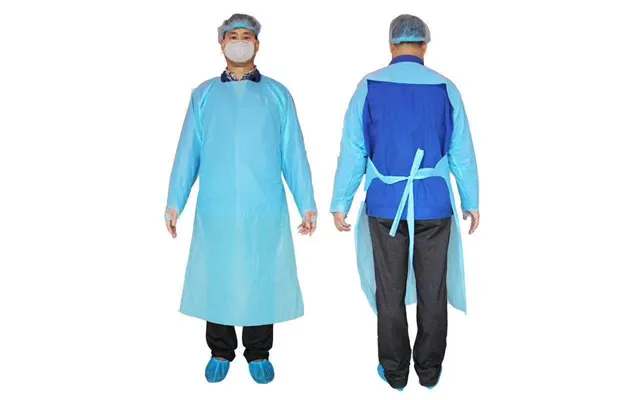
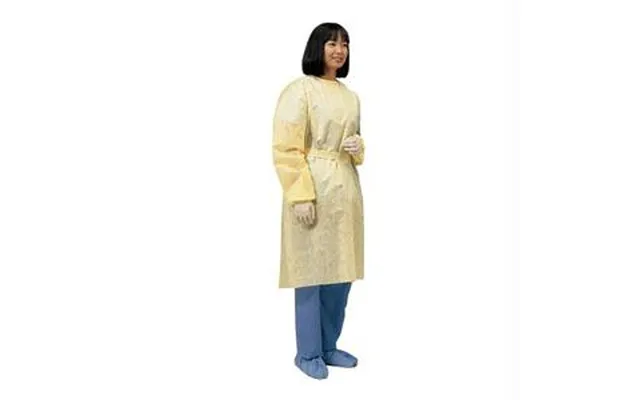
The listings include several isolation gown designs in yellow. These include lightweight gowns, a Level 2 isolation gown with tape, and disposable Level 1 isolation gowns. Isolation gowns can be compared by their listed protection level, closure method, material description, size, and intended use.
The Disposable Lev 1 Isolation Gowns Each listing describes long sleeves, elastic cuffs, lightweight breathable materials, and a disposable design. The description positions them for low-risk fluids and particles, patient interaction, and general clinical use. Since the data specifically identifies these as Level 1, shoppers should compare them with higher-level options when the work requires a different degree of protection.
Two listings focus on sterile-back or surgical-style gowns. The Standard Sterile-back Surgical Gown is listed as large, disposable, latex-free, and supplied with a towel. The Exam Gown Sterile Back With Towel is listed as extra-large and disposable, also with a towel.
These details are useful when comparing procedural garments. Sterile-back construction, disposable use, and the inclusion of a towel are all specifically stated in the listings. However, shoppers should still review the complete product information before deciding whether a gown matches a particular clinical protocol.
The Anti-static Microporous Breathable Coveralls With Hood And Boots listings differ from the gown products because they describe a more enclosed garment. The available sizes shown in the data are 2X-large and 4X-large. Both listings include a hood and boots, and both are described as anti-static and breathable.
A coverall can be compared when a gown does not provide the style of coverage required for the task. The hood and boots are especially important features to notice, because they extend the garment beyond the torso and sleeves.
The reference data includes a range of listed prices, from the Disposable Lev 1 Isolation Gowns Each at $5.27 to the Tieback Patient Gown in Blue Plaid at $22.45. Other examples include the Lightweight Isolation Gown Yellow Universal at $6.82, the Standard Sterile-back Surgical Gown at $7.03, and the Lightweight Isolation Gown in Universal size at $9.07.
The Isolation Gown With Tape, AAMI Level 2, is listed at $10.10, while the Lightweight Isolation Gown in X-large is listed at $10.93. The same X-large lightweight isolation gown title appears with both a package-style brand code and a case-style brand code, so shoppers should pay close attention to the product code and packaging information before comparing value.
The two listed coveralls are priced at $13.71 for the 2X-large version and $15.17 for the 4X-large version. The Exam Gown Sterile Back With Towel is listed at $32.88. Price alone does not tell the entire story, though. A lower-priced gown may be disposable or intended for basic coverage, while another garment may include a different construction, size, or use case.
Some listings include a regular price alongside the current listed price. For example, the Lightweight Isolation Gown in X-large is shown at $10.93 with a regular price of $21.91. The Isolation Gown With Tape, AAMI Level 2, is listed at $10.10 with a regular price of $12.21. The Universal Lightweight Isolation Gown is listed at $9.07 with a regular price of $15.01, and the Lightweight Isolation Gown Yellow Universal is listed at $6.82 with a regular price of $11.99.
Other products show a regular price of $0.00 in the supplied data. Because that information does not provide a meaningful comparison price, it is safer to focus on the listed price rather than describe those products as discounted. Checking the package or case details is also important, because the value depends on how many gowns are included.
Size is one of the easiest details to overlook and one of the most important. The listings include universal, one size, large, extra-large, 2X-large, and 4X-large options. A universal garment may be convenient for shared clinical use, while a specifically sized gown can offer a more predictable fit.
The Lightweight Isolation Gown - Yellow is listed in X-large, while another Lightweight Isolation Gown Yellow Universal is listed as universal. The surgical gown listing is large, and the sterile-back exam gown is extra-large. The coverall listings are available in 2X-large and 4X-large.
A good comparison starts with the wearer’s clothing size, movement needs, and the type of clothing worn underneath. The garment should allow comfortable movement without creating unnecessary loose material. For a shared supply, universal sizing may simplify selection, but a specific size may be preferable when fit and coverage are priorities.
The Tieback Patient Gown in Blue Plaid is described as one size fits all. Several lightweight isolation gown listings are described as universal. These designs can make stocking easier because staff do not need to manage as many size variations.
Still, “universal” does not automatically mean every wearer will experience the same fit. Treat the label as a sizing category, then review the full product information for details about the cut, closures, cuffs, and coverage.
For shoppers looking for larger garments, the data includes an X-large lightweight isolation gown, an X-large sterile-back exam gown, a 2X-large coverall, and a 4X-large coverall. These options may be useful when additional room is needed for movement or clothing underneath.
As with any protective garment, the best size balances coverage and comfort. A garment that is too tight may restrict movement, while one that is too loose may be difficult to manage during work.
Material descriptions help explain how products differ. The Lightweight Isolation Gown - Yellow is described as latex-free. The Universal Lightweight Isolation Gown is described as a single-layer spunbonded polypropylene garment with a waist belt and elastic cuffs. The Disposable Lev 1 Isolation Gowns Each are described as lightweight and breathable, with long sleeves and elastic cuffs.
The Tieback Patient Gown uses a 50/50 cotton-polyester construction. In contrast, the coveralls are described as microporous and breathable, with anti-static properties, a hood, and boots. These construction details provide useful clues about the garment’s design, but they should not be treated as interchangeable performance claims.
Several listed garments specifically identify themselves as latex-free, including the X-large Lightweight Isolation Gown - Yellow, the Standard Sterile-back Surgical Gown, and the Universal Lightweight Isolation Gown. If latex avoidance is important for your purchasing requirements, these descriptions make those products easier to identify during comparison.
Always distinguish between a product that is specifically described as latex-free and one where the material information is simply not provided. Missing information should not be interpreted as confirmation.
Closures influence how quickly a garment can be put on and adjusted. The Tieback Patient Gown uses tie-tape closures along a centered back opening. The Isolation Gown With Tape includes tape in its product name, while the Universal Lightweight Isolation Gown includes a waist belt and elastic cuffs in its description.
The Disposable Lev 1 Isolation Gowns Each are also described with elastic cuffs. These features can help shoppers compare practical use, especially when staff need to change gowns efficiently or when the garment must stay in place during movement.
Disposable gowns are designed for single-use convenience, and several listings explicitly use the word “disposable.” These include the Standard Sterile-back Surgical Gown, the Exam Gown Sterile Back With Towel, and the Disposable Lev 1 Isolation Gowns Each. Disposable products can simplify supply management when garments need to be changed between users or tasks.
The Tieback Patient Gown stands apart because its 50/50 cotton-polyester construction and traditional patient-gown format suggest a different purchasing consideration. The reference data does not state a specific cleaning or reuse policy for this product, so shoppers should avoid assuming details that are not listed.
When comparing disposable and non-disposable-style garments, consider the purpose, the required workflow, and the information supplied by the listing. It is much like choosing paper towels versus a cloth towel: the better choice depends on how the item will be used and managed.
The reference data identifies the Disposable Lev 1 Isolation Gowns Each as Level 1 and the Isolation Gown With Tape as AAMI Level 2. This distinction is important because the listings present them as different protection categories.
The Level 1 description refers to basic protection against low-risk fluids and particles and mentions general clinical use and patient interaction. The Level 2 gown is identified by its AAMI Level 2 designation, universal sizing, yellow color, and tape closure. These details can help buyers organize options according to the demands of the environment.
Do you need basic coverage for routine interaction, or does your setting call for a different protection classification? Reviewing the stated level is a better starting point than judging a gown by color or weight alone.
Separate your needs into categories such as patient care, general clinical use, examinations, surgical procedures, or more extensive protective coverage. This immediately narrows the selection. Patient gowns, isolation gowns, sterile-back gowns, and coveralls each serve different roles in the listings.
Make a list of the sizes your users need. The reference data includes one size, universal, large, X-large, 2X-large, and 4X-large options. A simple size checklist can prevent an otherwise suitable product from being overlooked or ordered in the wrong size.
Look for the features that matter to your workflow: latex-free wording, elastic cuffs, waist belts, tiebacks, tape closures, long sleeves, hoods, boots, breathability, and sterile-back construction. These details are more useful than choosing based on appearance alone.
The brand or product codes in the data include terms such as “Each,” “Pack(age),” and “Case.” The listings do not provide a complete quantity breakdown for every item, so confirm the package size before calculating the true cost per gown. A listed price is only one part of the value equation.
For a lower listed price among the supplied offers, the Disposable Lev 1 Isolation Gowns Each appears at $5.27, while the Lightweight Isolation Gown Yellow Universal appears at $6.82. The Standard Sterile-back Surgical Gown - Large is listed at $7.03 and includes a towel according to its description.
For a universal lightweight option, the listing priced at $9.07 identifies latex-free construction, a waist belt, and elastic cuffs. The AAMI Level 2 Isolation Gown With Tape is listed at $10.10. The X-large Lightweight Isolation Gown is listed at $10.93, and the data includes a latex-free description.
For larger, more enclosed garments, the 2X-large coverall is listed at $13.71 and the 4X-large coverall at $15.17. For a patient-gown format, the Blue Plaid Tieback Patient Gown is listed at $22.45. The Exam Gown Sterile Back With Towel is listed at $32.88 and is identified as extra-large and disposable.
The best hospital gown is the one that matches the task, fit, construction, and workflow. The listings in this comparison include basic Level 1 isolation gowns, AAMI Level 2 options, lightweight yellow gowns, sterile-back surgical and exam gowns, a tieback patient gown, and microporous coveralls with hoods and boots.
Use the listed information as a starting point: identify the required protection category, select the correct size, review the closure and material details, and verify packaging before making a cost comparison. ZoneOffer helps you compare these options, but it is not a store. By treating each listing like a piece of a larger puzzle, you can build a more practical and informed hospital gown purchasing plan.